Getting started
Frappe Playground starts a local Frappe site in your browser. There is no account to create and no remote server to configure.
Browser requirements
Use a current desktop or mobile browser with WebAssembly, ES module workers, Service Workers, IndexedDB, and cross-origin isolation support. The tested minimums documented by the project are Chrome/Edge 80, Safari/iOS 15, and Firefox 114. A newer release is strongly recommended because the runtime is large and worker behavior has improved over time.
The page must be served from localhost or over HTTPS. Opening the generated HTML directly from disk will not work.
First boot
- Open the playground URL.
- Wait while the Service Worker starts, Pyodide loads, the Frappe filesystem is installed, and the site database is seeded or restored.
- Sign in with the demo credentials:
Username: Administrator
Password: admin
On a new instance, Frappe may show its Setup Wizard. Complete it normally, or use the onboarding=0 boot flag for an automated disposable demo.
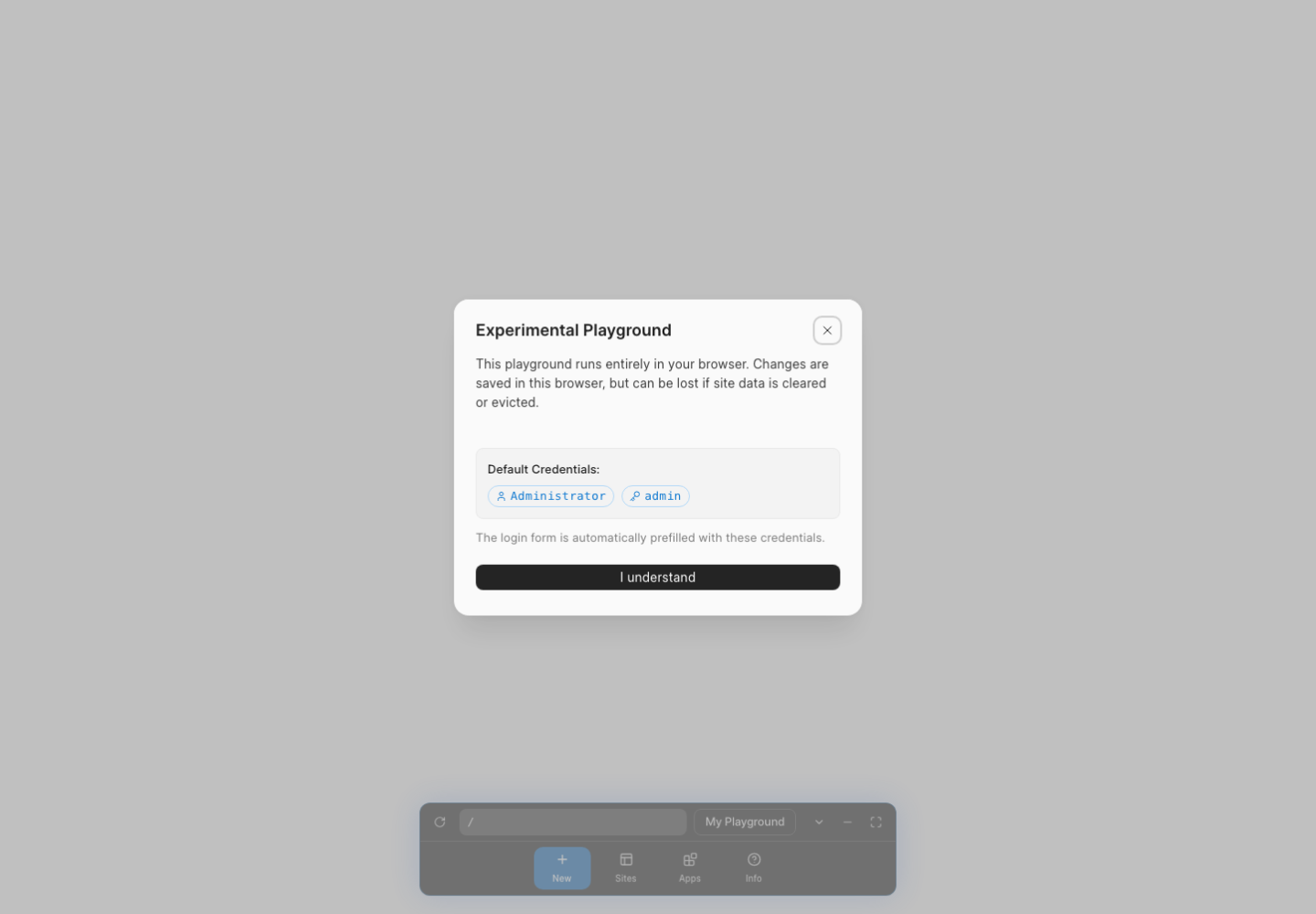
The first-run notice repeats the demo credentials. Select I understand to dismiss it; the sign-in form behind it is already filled in.
Demo credentials
The default password and disabled CSRF checks are intentional browser-playground defaults. Do not treat this runtime as a security boundary or reuse this configuration for an internet-facing Frappe server.
The dock
The shell’s dock provides access to the playground iframe, instance manager, and optional-app manager. A playground instance is a local browser site, not a remote deployment. See Playground interface for every control and its navigation behavior.
The initial boot can take noticeably longer than later visits. Browser caching avoids refetching unchanged runtime assets, while IndexedDB restores your site state.
What survives a reload?
The active instance’s SQLite database, cookie jar, uploaded public/private files, and installed-app list are checkpointed to IndexedDB. The shell’s instance names and active selection live in localStorage.
See Instances and storage for the exact lifecycle and deletion behavior.